

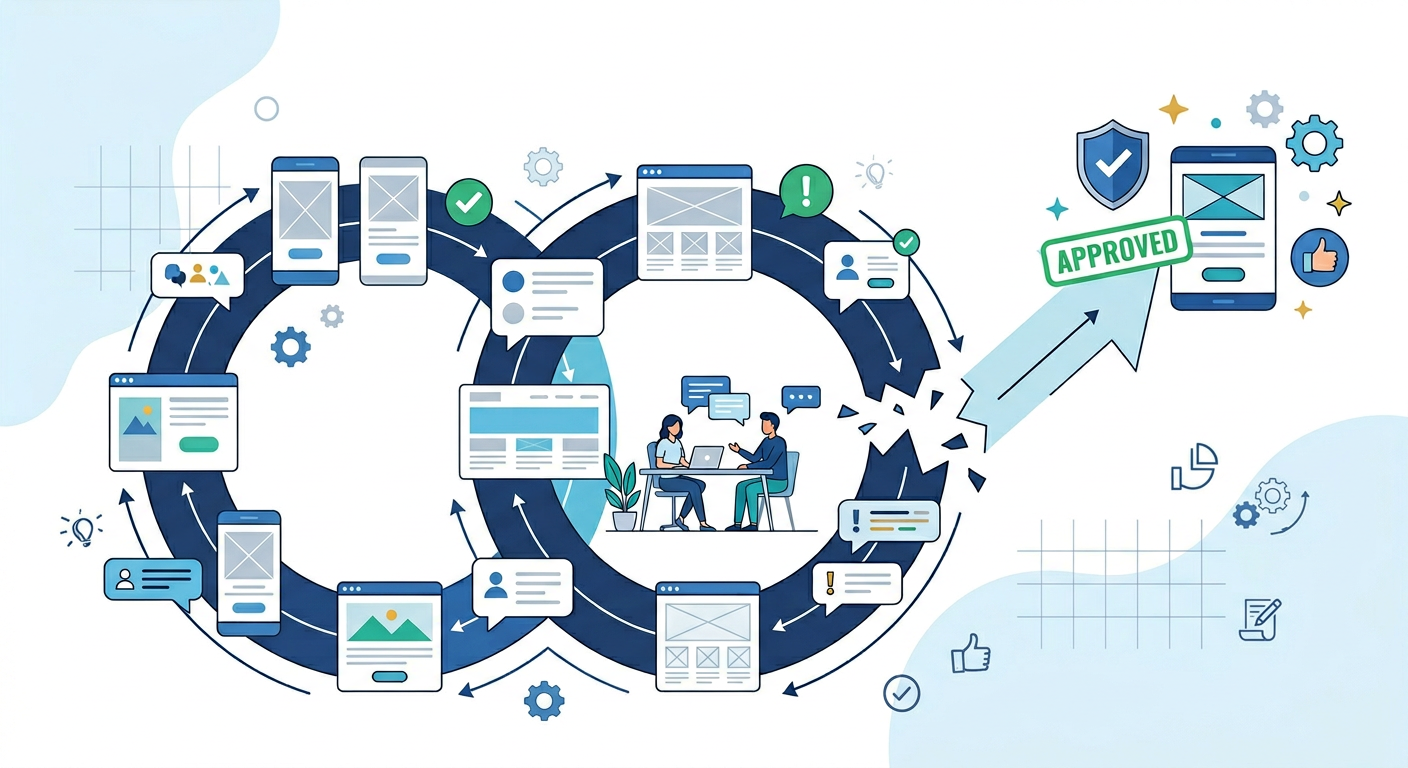
Infinite feedback loops in design projects are a process problem, not a talent problem. When a project enters its fourth, fifth, or sixth round of revisions without moving closer to approval, the root cause is almost never the quality of the creative work. It is almost always a failure in how feedback is collected, communicated, and acted upon.
Understanding this distinction matters, because it changes where you intervene. Asking a designer to "just try something different" does nothing to fix a broken approval structure. The loop continues regardless of how strong the creative output is.
The single clearest warning sign is when feedback revisits something that was already signed off in a previous round. A stakeholder who approved the colour palette in round one suddenly raises concerns about it in round three. This is not a creative problem — it is a visibility problem. There is no shared record of what was agreed, so earlier decisions feel open for renegotiation.
When different stakeholders review the same version independently and send feedback at different times, designers end up acting on partial information. They revise for one stakeholder's comments, only to receive conflicting direction from another stakeholder two days later. Each revision introduces new variables, and the project drifts further from alignment rather than closer to it.
"This doesn't feel quite right" and "I'm not sure about the layout" are common — and almost useless — pieces of feedback. Vague, subjective comments without a suggested direction force designers to guess at the intent, which means each revision is essentially a new creative gamble. When the guess misses, another round begins.
Feedback loops accelerate when it is unclear who has final say. If five people can each request changes and no single person can close a revision round, the project will keep moving. Every new voice carries equal weight, and consensus — if it ever arrives — takes far longer than a clear hierarchy would require.
Scope creep is one of the most common drivers of endless revisions. The original brief asked for a single-page flyer; midway through reviews, someone suggests it should now work as a social post and an email header too. Each expansion of scope resets the feedback cycle, because reviewers are now evaluating against new requirements the design was never built to meet.
Prevention is significantly more effective than correction. Before any creative work is reviewed, all stakeholders should formally acknowledge the project brief. This does not need to be a lengthy document — a one-page summary of objectives, audience, format, and constraints is enough. What matters is that everyone has read and agreed to the same starting point. When scope creep emerges later, the brief becomes the reference point that ends the conversation quickly.
The most impactful single change most teams can make is shifting from sequential, individual feedback to consolidated, simultaneous feedback. Every stakeholder reviews the same version at the same time, and all comments are gathered into one structured list before the designer touches the file. This eliminates conflicting revision chains and gives the designer a complete picture of what needs to change before they start.
GoProof is built around exactly this model — all reviewers annotate directly on the live proof, their comments are visible to each other in real time, and nothing moves forward until feedback has been collected from everyone required to sign off.
Every review round should have one named person responsible for synthesising stakeholder input and presenting a consolidated, prioritised list of changes to the design team. This is not about excluding voices — it is about translating multiple perspectives into coherent direction. The feedback owner also has authority to resolve conflicts between stakeholders before the revision begins, rather than leaving those conflicts for the designer to navigate mid-revision.
Teams that define a maximum number of revision rounds before a project begins — typically two to three rounds for most creative deliverables — complete projects measurably faster than those that treat revisions as open-ended. Communicating this limit at the project kickoff changes reviewer behaviour: stakeholders tend to be more thorough and considered in their feedback when they know rounds are finite.
One of the most underappreciated tools for breaking feedback loops is a clear record of what was reviewed, what was changed, and who approved it. When earlier decisions are visible to all stakeholders, the temptation to reopen settled questions drops considerably. In GoProof's experience, teams that maintain a structured approval audit trail spend significantly less time in late-stage revision rounds — because there is a shared record to point to when a previously approved decision re-emerges as a comment.
Some feedback loops cannot be broken asynchronously. When written comments have reached a fifth round without resolution, the fastest intervention is often a 20-minute video call with the key decision-makers. A real-time conversation surfaces the actual concern behind vague feedback far more efficiently than another written revision cycle. The goal is not to bypass the process — it is to restore shared understanding before the next round begins.
Most prolonged revision loops are caused by fragmented feedback — different stakeholders reviewing separately and at different times — rather than genuine creative disagreement. When feedback is consolidated before revisions begin, and a single person owns the direction for each round, most projects resolve in two to three rounds rather than five or six.
Two to three revision rounds is the widely accepted benchmark for most standard creative deliverables, such as brochures, social assets, or email designs. Projects exceeding four rounds without nearing sign-off typically indicate a process problem — either a drifting brief, unclear decision-making authority, or unconsolidated feedback — rather than a creative quality issue.
The most effective method is maintaining a visible, shared record of what was approved at each stage of the review. When all stakeholders can see the history of decisions — including who approved what and when — it is much harder to reintroduce settled questions. Structured proofing tools like GoProof support this by creating an audit trail that is accessible to everyone involved in the project.
The fastest single intervention is replacing the next written revision round with a short live conversation between the key decision-makers. Vague or conflicting written feedback often masks a simpler underlying concern that can be identified and resolved in minutes during a direct conversation. Once that concern is clear, the designer can act on precise direction rather than guessing again.
Defining a maximum number of revision rounds upfront shifts the incentive for reviewers: rather than deferring thorough feedback to a future round, stakeholders are more likely to review carefully and consolidate their input the first time. Teams that set and communicate revision limits consistently report fewer total rounds and faster time-to-approval than those that leave the process open-ended.


